The short version
Five things decide a beginner’s score on a 10m air rifle: a stable stance, a consistent grip and cheek position, a sharp, clear sight picture, steady breathing with the breath held at the right moment, and a smooth trigger release to finish the shot. None of them needs strength or experience. They need you to do the same thing, the same way, on every shot.
The technique in this guide follows the textbook Kỹ thuật và phương pháp tập luyện Bắn súng thể thao (Sport Shooting Techniques and Training Methods), published by Vietnam’s Sports Publishing House (Nhà xuất bản Thể dục Thể thao), and the method our range staff teach at Saigon Sniper. This guide covers technique only. For how the range keeps you safe, read is sport shooting safe before your first visit.
Stance
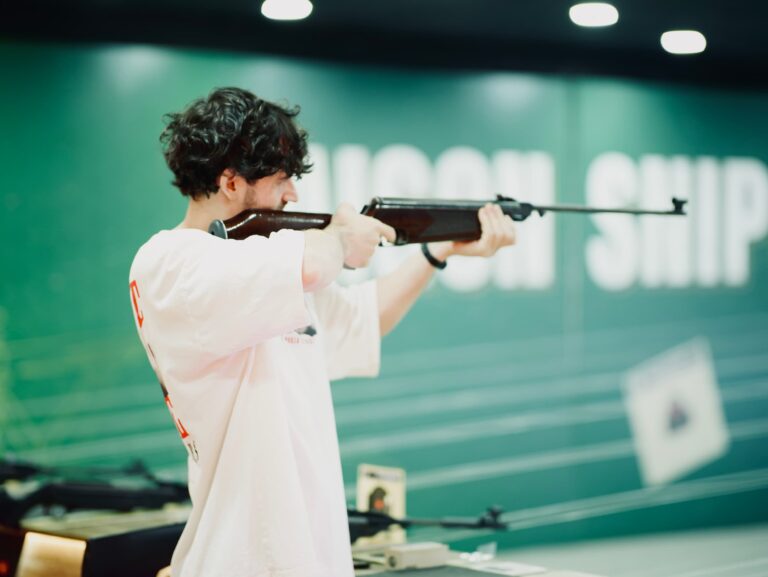
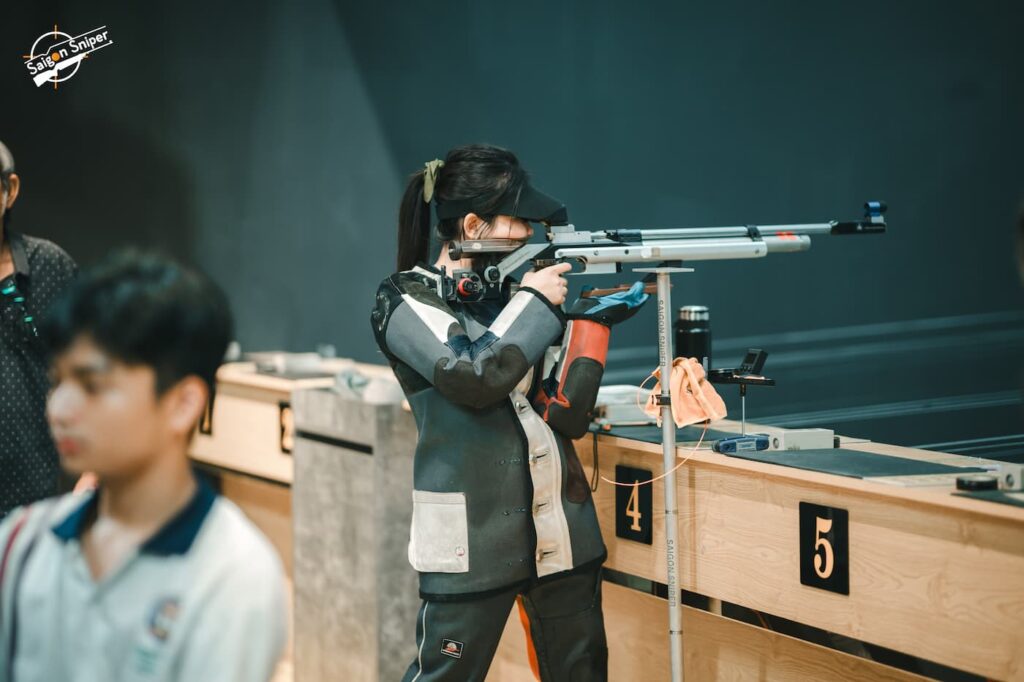
Most first sessions are shot standing, which is also the hardest position to hold still. A correct stance greatly reduces the effort needed to hold the rifle and the wobble that your body passes on to it.
- Stand side-on to the target. If you shoot right-handed, your left shoulder points towards the target; if you shoot left-handed, it is the other way round.
- Feet shoulder-width apart or slightly wider, weight spread evenly between both feet, knees straight and the leg muscles relaxed.
- Lean slightly back, with your hips pushed towards the target, to balance the weight of the rifle in front of you.
- Rest your supporting elbow on top of your hip bone and keep your upper arm against the side of your ribcage rather than holding it out in the air. Using your skeleton as support is steadier than using muscle.
Then check your natural point of aim. Settle into position, close your eyes for a few seconds, relax and open them. If the rifle has drifted off the target, move your feet slightly rather than forcing the rifle back with your arms. Muscles get tired and start to shake; a well-aligned stance saves you from constantly fighting to hold the sight picture.
Grip and cheek position
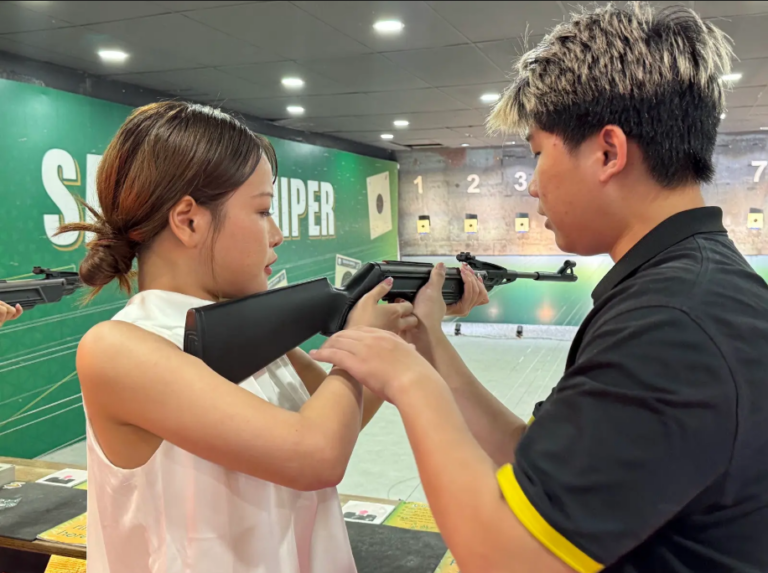
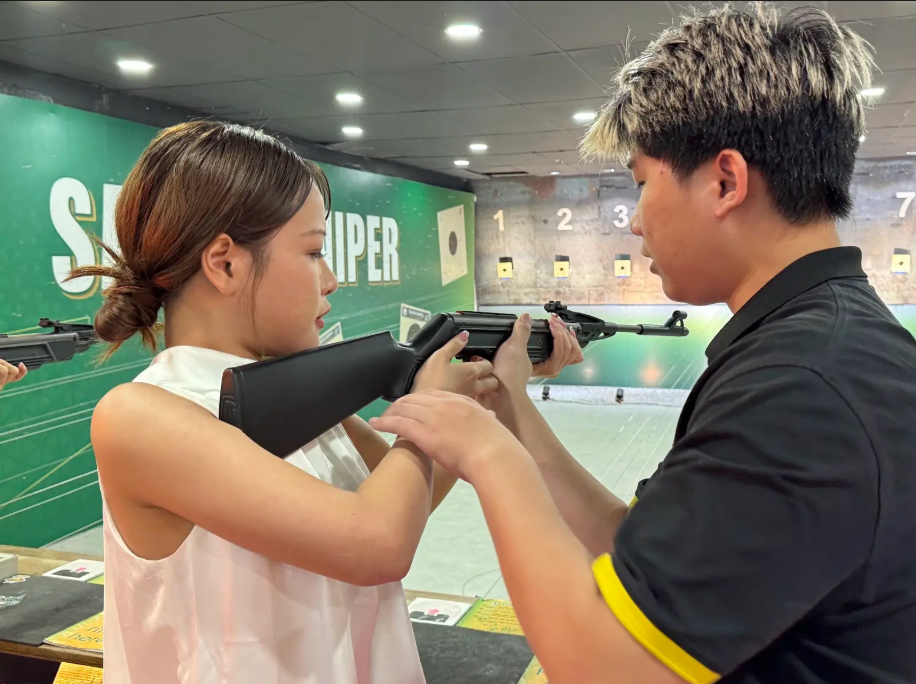
Your shooting hand holds the grip firmly but not tightly, roughly like a firm handshake. Squeezing too hard makes the muzzle tremble, pulls the shot as you press the trigger and tires your hand quickly.
The supporting hand does not grip at all. Let the rifle rest on your open palm, fingertips or fist, whichever works for you to hold it at target height while your elbow stays on top of your hip bone.
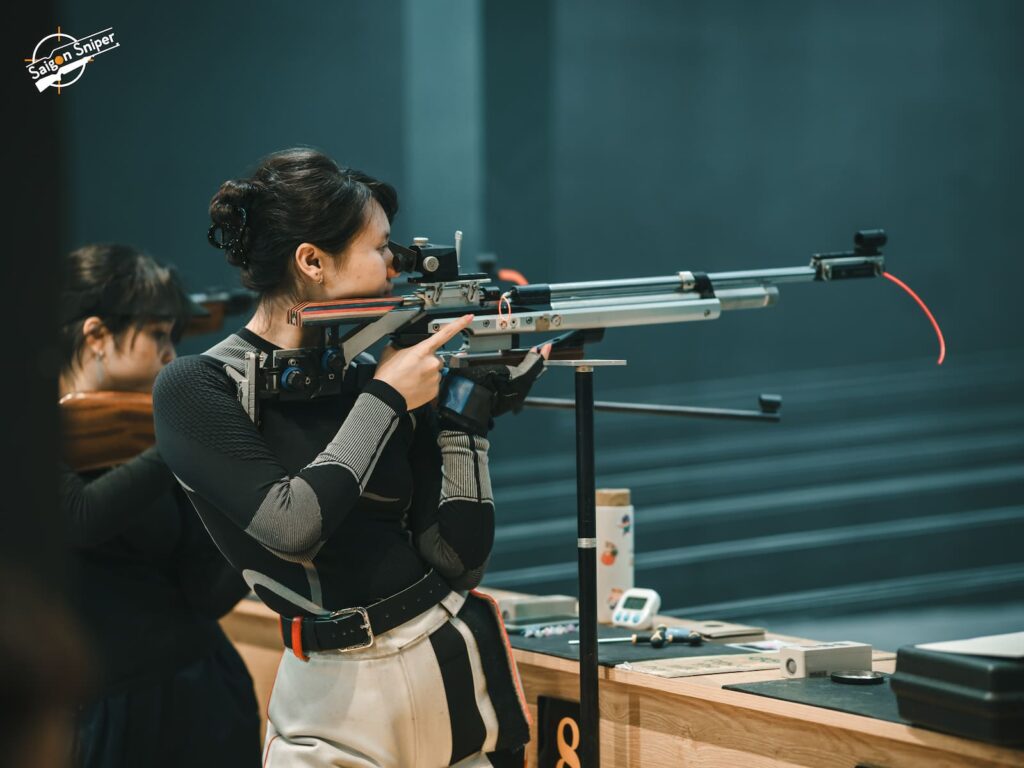
The most overlooked part is the cheek. Rest your cheek on the stock at exactly the same spot for every shot, with your head upright rather than tilted. If your cheek moves, your eye moves, and the sights line up differently each time even when everything else is right. Range staff can help you find a comfortable spot during the briefing.
Sight picture: the three-stage method
Aiming is where most beginners lose points, usually because they stare hard at the target. When you look at the target too much, the sight picture blurs and drifts without you noticing. The method used at Saigon Sniper, based on the same textbook, breaks aiming into three stages:
- Line up the basic sight picture. Look through the rear sight notch and place the front sight in the centre of it, so that the top of the front sight is level with the top of the two shoulders of the notch. Focus on this basic sight alignment, not on the target.
- See the front sight clearly and bring it onto the target. Keep the front sight sharp and let the target stay slightly blurred. Settle the sight picture on the target and wait for the small movements to calm down.
- About a second before the shot, shift your focus outwards. As you are about to finish the shot, bring your eyes back to see the basic sight alignment clearly once more, then look through the sights towards the target rather than locking onto the front sight alone.
The rifle will never sit perfectly still, even for experienced shooters. Your goal is a small, steady wobble around your aiming point, not a frozen picture.
Breathing
Breathing moves your chest, and your chest moves the rifle. The usual approach:
- Take three or four normal breaths while you settle your aim on the target.
- Breathe out, or in, about halfway and pause naturally.
- Take the shot within the next few seconds while you are still and comfortable.
If you have held your breath too long and the shot still is not right, lower the rifle, breathe normally and start again. Holding on longer only makes the wobble worse.
Trigger control
Build pressure on the trigger steadily instead of jerking it. Place the pad of your index fingertip on the trigger and press straight back, increasing the pressure gradually until the shot goes. Ideally, the moment the rifle fires should come as a slight surprise.
Two habits make a big difference:
- Move only your trigger finger. The finger works on its own, while your hand, wrist and whole arm stay exactly where they were.
- Follow through. Keep your cheek, eye and finger in place for a second after the shot. Lifting your head to check the target before the pellet has left the barrel is one of the most common causes of a low shot.
Putting it together: a routine for every shot
Good shooters do not think about five things at once. They run the same short routine before every shot, so the technique becomes automatic. Try this one on your first target:
- Set your stance and check your natural point of aim.
- Mount the rifle with your cheek in the same spot on the stock.
- Settle the sights using the first two stages of the sight picture.
- Breathe in or out about halfway and pause.
- Press the trigger with smoothly increasing pressure while shifting your focus out to the target.
- Follow through for a second, then lower the rifle and breathe normally.
Between shots, take a few seconds to rest your arms and look away from the sights. Your eyes tire quickly when you aim, and a short break helps the next sight picture stay sharp. If a shot felt wrong before you pressed the trigger, it is fine to lower the rifle without shooting and start the routine again.
After each target, look at where your shots landed rather than just the score. A tight group away from the centre usually means your technique is consistent and only small adjustments are needed. Shots spread all over the target usually point back to sight alignment, grip, cheek position or trigger control. Range staff can read a target with you and suggest what to try next.
Common first-timer mistakes
- Gripping too hard. A tight grip makes the rifle shake and pulls the shot sideways.
- Tensing your arms to hold the rifle up. Rest the elbow on top of the hip bone and let the skeleton carry the weight.
- Staring at the target instead of the sights. The sight alignment should be the clearest thing you see.
- Jerking the trigger at the “perfect” moment. A sudden jerk moves the rifle more than the wobble you were trying to beat, and you lose that perfect moment anyway.
- Changing everything after each shot. Shoot a few shots before you judge your grouping; one bad shot does not mean the whole technique is wrong.
- Rushing. There is no time pressure. Lowering the rifle and starting again when you cannot settle is normal, and competitive shooters do it too.
Frequently asked questions
How many shots does it take to get the hang of it?
On a first visit, the first 30 shots usually go on getting used to the stance, the sights and the trigger. A 60-shot package gives you more time to repeat the basics at your own pace once they start to feel familiar. Packages and prices are listed in our price guide.
I’m left-handed. Can I still shoot?
Yes. Tell the range staff during the briefing, and they will help you set up your stance and grip for your dominant side.
Can I shoot with glasses?
Yes. Glasses and contact lenses both work fine. The target is 10 metres away and you aim through the rifle’s sights, so being short-sighted is not a barrier. Just make sure your glasses or lenses have the correct prescription.
Can I shoot seated?
Yes, on the Advanced tier only, which offers seated shooting with support equipment at the bench. The Classic and Sporty tiers are shot standing.
What score is good for a first time?
Each target takes 10 shots, scored up to 10 points each. Averaging around 7 points a shot, or 70 points on a target, is a solid result for a first visit with good technique. Do not worry if your first target is lower: scores usually rise as the session goes on.
Try it on the range
The fastest way to learn is with a rifle in your hands and range staff beside you. Book your session at Saigon Sniper, open daily from 8:00 to 22:00.